

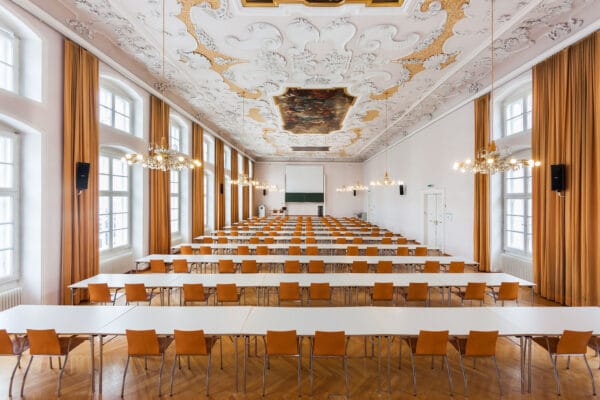
NAME:
Theologie - MS
BUILDING:
Theologie
FLOOR:
2
TYPE:
Lecture Room
CAPACITY:
108
ACCESS:
Only Participants
EQUIPMENT:
Beamer, PC, WLAN (Eduroam), Overhead, Flipchart, Blackboard, Handicapped Accessible, LAN, Microphones, Sound System
Mountain ecosystem services, such as food, feed or water provision to name a few, are intrinsically linked to land use and land cover (LULC) patterns. These evolving patterns are shaped by both societal decisions and biophysical constraints. Understanding and managing how these services react to climate change requires an integrated perspective that accounts for the interplay between land management and evolving environmental conditions. While high-resolution land use data from the late 20th century provides valuable insights into the societal processes driving LULC change and related ecosystem services, it is insufficient for inferring future constraints under shifting climatic regimes.
To robustly assess future land use and ecosystem service change, we propose a modelling pipeline that couples a statistical, pattern-based land use change model to a process-based ecohydrological landscape model. By coupling these models through shared land cover classes and ecohydrological variables, the pipeline complements purely statistical descriptions of land use change, aiming to better represent ecological succession in deglaciating areas, greater primary productivity resulting from higher temperatures and earlier snowmelt, as well as potentially declining ecosystem services due to increased drought frequency and reduced glacier runoff. The ecohydrological component generates land use suitability covariates that inform the statistical model, while incorporating optional management scenarios (forestry, irrigation, reservoirs) to constrain land use outcomes to realistic boundary conditions. This integrative approach provides a robust basis for projecting future ecosystem services provision. Applied to the Swiss alpine region, it has the potential to support both conservation and adaptive management in the context of ongoing environmental and societal change.
We and use cookies and other tracking technologies to improve your experience on our website. We may store and/or access information on a device and process personal data, such as your IP address and browsing data, for personalised advertising and content, advertising and content measurement, audience research and services development. Additionally, we may utilize precise geolocation data and identification through device scanning.
Please note that your consent will be valid across all our subdomains. You can change or withdraw your consent at any time by clicking the “Consent Preferences” button at the bottom of your screen. We respect your choices and are committed to providing you with a transparent and secure browsing experience.