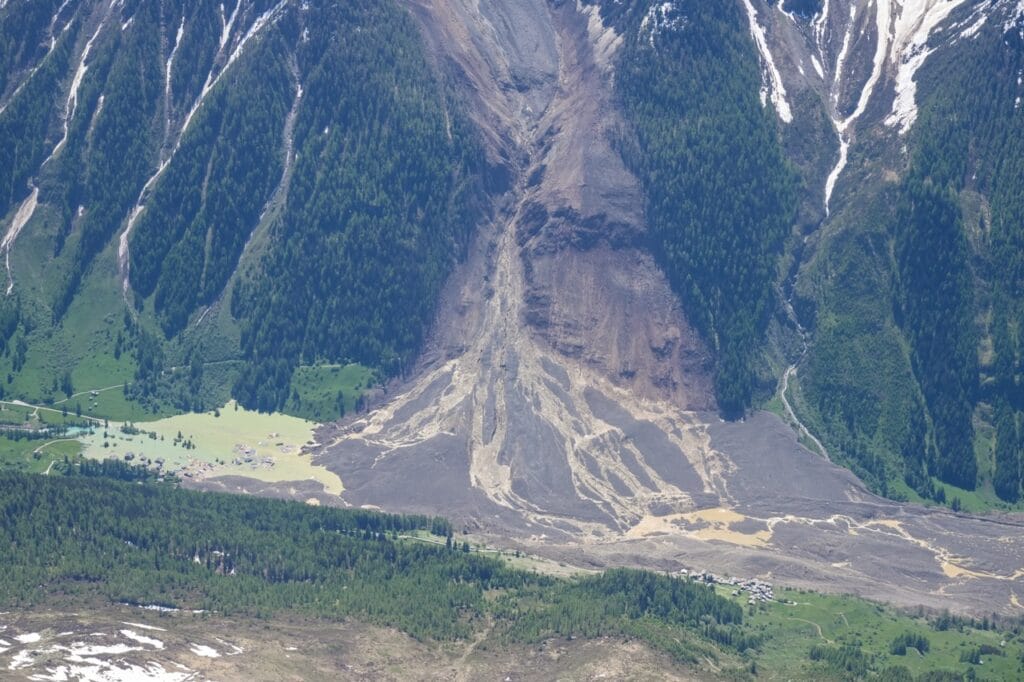
Field investigations and numerical modeling of the 28 May 2025 Blatten landslide suggest basal liquefaction and ice-related friction reduction could have contributed to its large mobility.
Photogrammetric reconstruction of the Blatten glacier collapse from oblique Rapid Mapping imagery
A digital elevation model of the Blatten glacier collapse was derived from rapid mapping imagery, allowing 3D visualization of the event and estimation of volume changes.
The May 2025 rock-ice avalanche of Blatten (CH): Preliminary seismologic and permafrost studies and outlook for interdisciplinary research
We present preliminary seismologic and permafrost studies on the May 2025 rock-ice avalanche of Blatten, as well as an outlook of potential interdisciplinary research avenues.
Monitoring of the “Kleines Nesthorn” and of the Birch Glacier before and during the rock avalanche in Blatten
The presenters will show you at the example of Blatten how a monitoring solution for a natural hazard can look like and what challenges we face.
Granular flow modelling of the May 2025 Blatten, Switzerland Ice–Rock Avalanche
We performed post-analysis on the Blatten event by constraining numerical modeling results with the force-time function inverted from remote seismic stations as well as the DEM analysis on the final deposits.
Mountain disasters and local population: a dual monitoring approach.
Mountain disasters will become increasingly frequent. To assure the safety of the local population, a dual approach should be adopted: monitoring of the phenomena and the socio-economic fragilities.
Automatic Weather Stations (AWS) in the Maloti-Drakensberg Mountains: Spatial Distribution, Applications, and Early Climate trends
This study assesses the advantages of automatic weather stations in the mountainous regions. It evaluates the applications of weather data on sectors that are climate-sensitive.