
Deep permafrost warming relates to weakening stability down to tens of meters depth
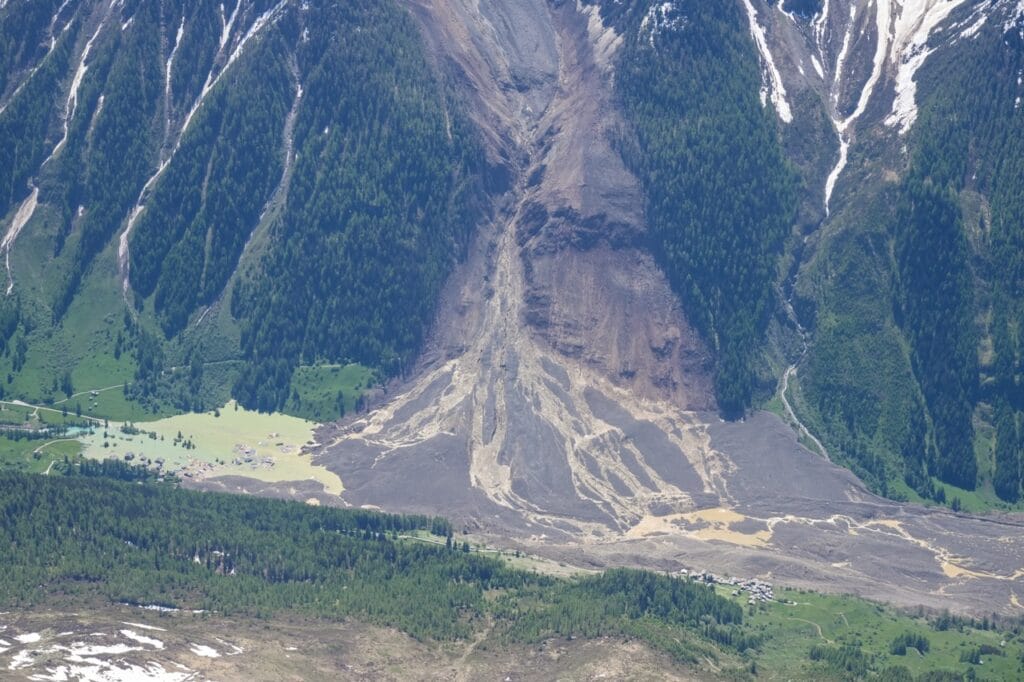
Early detection of slope instability with satellite radars before Blatten rock/ice avalanche
Targeted back-analysis of synthetic aperture radar dataset over the Kleines Nesthorn
Integrated Analysis of the Blatten Rock-Ice Avalanche: Seismology, Geomorphology, and Modeling
To better understand the dynamics of events like the rock avalanche in Blatten, we conduct research that combines seismic signal analysis, geomorphological observations, and numerical simulations.
Hard-bed physics framework and transient friction applied to the Birch glacier collapse: analysis of the detachment mechanisms.
On May 28, 2025, Birch Glacier collapsed due to rock overload, triggering a devastating avalanche. Elmer/Ice simulations reveal stress redistribution and detachment mechanisms leading to catastrophic glacier failure.
Predicting rock avalanche runout: The potential of the kinetic friction angle
Estimating the kinetic friction angle from the volume to parameterize a Savage-Hutter model and a Fahrböschung model can reconstruct the Blatten event and may predict future events.
Understanding the role and impacts of non-academic actors’ involvement in natural hazard and disaster risk research: Insights from Nepal
This study examines how non-academic actors contribute to natural hazards and disaster risk research in Nepal, analyzing participation strategies, methodological challenges, and potential impacts.
Geospatial Solutions for Landslide Risk Assessment and Mitigation Strategy
This research uses GIS, RS, and multi-scale modeling for landslide risk assessment and promotes rainwater harvesting as a mitigation strategy to enhance slope stability and disaster resilience.
Fungi in pine forest regeneration at the upper tree line under the climate change
To better understand the diversity, composition and possible roles, communities of fungi associated with Pinus heldreichii and P. peuce were studied in high-altitude forest sites in Montenegro.