

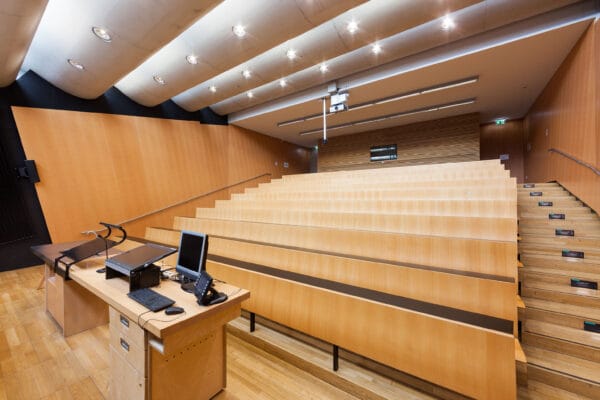
NAME:
SOWI - HS 2
BUILDING:
SOWI
FLOOR:
0
TYPE:
Lecture Hall
CAPACITY:
80
ACCESS:
Only Participants
EQUIPMENT:
Beamer, PC, WLAN (Eduroam), Overhead, Flipchart, Blackboard, Sound System, Handicapped Accessible, Light Installation
Land-terminating ice cliffs are rare but significant features of glacier surfaces, where atmosphere-cryosphere interactions are intensified by the cliffs’ vertical structure. While traditional glacier mass balance models often assume a relatively uniform, sloped surface, ice cliffs present distinct wind and radiative conditions that challenge this assumption. Due to their different exposure to radiative fluxes and the modulation of turbulent heat fluxes, ice cliffs can contribute disproportionately to glacier ablation, yet their representation in mass balance models remains limited.
To improve process-based understanding of glacier-atmosphere coupling at ice cliffs, we analyze turbulence and microclimate data from two contrasting sites: northern Greenland and Kilimanjaro. By integrating these insights into an energy balance framework, we aim to understand the representation of turbulent fluxes and their impact on ice cliff melt. The COSIPY mass balance model is applied to both the vertical ice cliff and the adjacent flat glacier surface, incorporating adaptations for the unique challenges of a steep ice wall. This approach enables an assessment of the differences in ablation drivers between the two regimes. This work advances our ability to model ice cliff mass balance by improving the parameterization of energy exchange processes. A better understanding of these processes is crucial for projecting the transient response of glaciers to climate change and refining energy balance models to account for complex surface geometries.
We and use cookies and other tracking technologies to improve your experience on our website. We may store and/or access information on a device and process personal data, such as your IP address and browsing data, for personalised advertising and content, advertising and content measurement, audience research and services development. Additionally, we may utilize precise geolocation data and identification through device scanning.
Please note that your consent will be valid across all our subdomains. You can change or withdraw your consent at any time by clicking the “Consent Preferences” button at the bottom of your screen. We respect your choices and are committed to providing you with a transparent and secure browsing experience.