
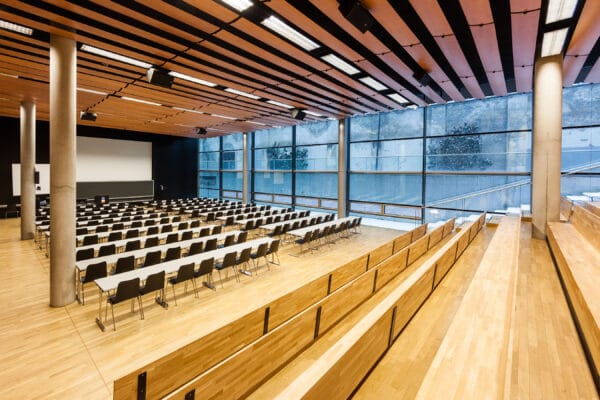
NAME:
SOWI - Aula
BUILDING:
SOWI
FLOOR:
0
TYPE:
Assembly Hall
CAPACITY:
450
ACCESS:
Only Participants
EQUIPMENT:
Beamer, PC, WLAN (Eduroam), Overhead, Flipchart, Blackboard, Sound System, Handicapped Accessible, Microphones, Light Installation
The Interdisciplinary Centre for Mountain Research of the University of Lausanne promotes inter- and transdisciplinary research on mountains. With 100 members from seven faculties and 40 partners, it is active in the Swiss cantons of Vaud and Valais, including the Lötschental.
The rock-ice avalanche of 28 May 2025 was monitored through low-cost seismic stations (RaspberryShake) in schools of the cantons of Valais and Vaud. These seismic stations had been installed in 2021 as part of an awareness-raising project on seismic hazard. The seismic magnitude equivalent of the energy released by the avalanche is ~3.1. Data from our network show the event across all Switzerland and reveal that the main avalanche lasted for about one minute, which is coherent with on-site observations. This low-cost network of seismic stations has multiple uses and can be easily set up anywhere by anyone, for educational or citizen science purposes.
We also started a project aiming at modelling permafrost conditions in the Kleines Nesthorn (initially 3341 m a.s.l.). Surface and depth temperature will be assessed using two different models for sub-vertical rock walls and for intermediate slopes covered by snow in winter. To calibrate the model with local data, we equipped with temperature sensors several slopes around the Schafbärg (3239 m a.s.l.), a summit located 1 km west from Kleines Nesthorn and that has similar altitude, exposure and geological conditions. 5 sensors were installed at the surface of rock walls and 10 sensors in rocky debris. The first data will be collected in summer 2026. We hope to gain a better understanding of the role of permafrost and its degradation in the Blatten disaster, already suggested by the presence of a rock glacier and a hanging glacier on both sides of the main scar, its high humidity several weeks after the event, and the presence of massive ice in secondary scars.
Looking ahead, research could be expanded into the social and social-ecological sciences. Dark tourism, crisis management, and adaptation to risk are some of the topics that could be explored.