

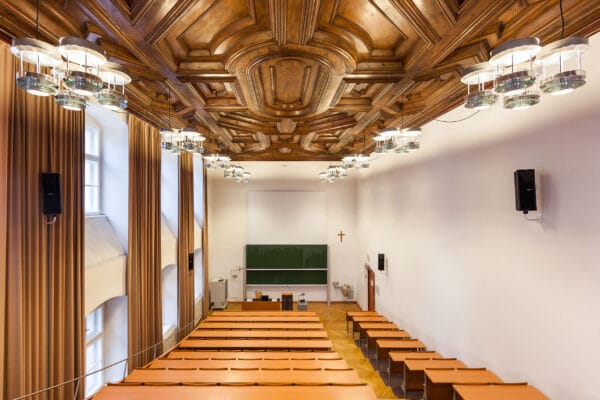
NAME:
Theologie - HS 1
BUILDING:
Theologie
FLOOR:
1
TYPE:
Lecture Hall
CAPACITY:
126
ACCESS:
Only Participants
EQUIPMENT:
Beamer, PC, WLAN (Eduroam), Overhead, Blackboard, Handicapped Accessible, LAN, Microphones, Sound System, Speaker Desk
Mountain ecosystems, celebrated for their high biodiversity and endemism, are experiencing rapid ecological shifts due to global change drivers. Both climate and land-use changes are increasingly altering species distributions, yet the scale at which these changes occur is often overlooked. Spatial heterogeneity in mountains arises not only from topography but is further amplified by bedrock and soil conditions, vegetation, and human activities, leading to high species turnover over small distances. To effectively assess biodiversity responses to climate and land-use change, it is crucial to capture these dynamics at appropriate spatiotemporal scales.
In this presentation, I will showcase insights from several global and regional long-term monitoring initiatives designed to quantify biodiversity variation across scales. The MicroFracNet project examines beta diversity patterns at multiple spatial resolutions, helping to disentangle the key drivers of species turnover. Complementary studies from the Mountain Invasion Research Network (MIREN) provide high-resolution assessments of shifting species distributions in space and time, including a fast trail survey that tracks the elevational range shifts of non-native species at a 5-meter resolution and the MIREN Rocks survey, which investigates the localized impacts of recreational climbing – interacting with extreme cliff microclimates – on cliff-face vegetation. Finally, I will discuss a unique long-term phenological survey in northern Scandinavia, where vegetation and its seasonal dynamics have been monitored every five days for the past decade, as well as in historical surveys dating back 110 years. This study provides rare insights into the temporal scale of biodiversity change and highlights the frequency of observations needed to accurately track the complexity of species redistributions.
By integrating these diverse monitoring efforts, this talk will highlight how fine-scale spatial and temporal variations shape species redistributions in mountain ecosystems. These insights are crucial for understanding the ecological mechanisms driving range shifts, ultimately informing conservation strategies to mitigate the impacts of global change on mountain biodiversity.
We and use cookies and other tracking technologies to improve your experience on our website. We may store and/or access information on a device and process personal data, such as your IP address and browsing data, for personalised advertising and content, advertising and content measurement, audience research and services development. Additionally, we may utilize precise geolocation data and identification through device scanning.
Please note that your consent will be valid across all our subdomains. You can change or withdraw your consent at any time by clicking the “Consent Preferences” button at the bottom of your screen. We respect your choices and are committed to providing you with a transparent and secure browsing experience.