

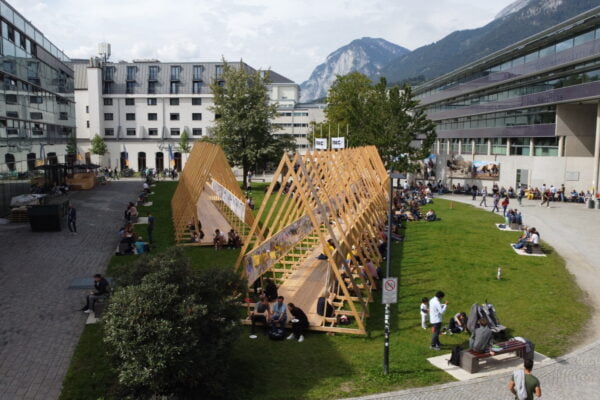
NAME:
SOWI - Garden
BUILDING:
SOWI
FLOOR:
0
TYPE:
Garden
CAPACITY:
2000
ACCESS:
Public Access
EQUIPMENT:
---
Protective forests are of critical importance to ensure the security of human life, infrastructure and stability of ecosystems in mountainous regions. Particularly in the Alps, natural disturbances, such as windthrows, fires and insect outbreaks, pose substantial challenges for planners and practitioners aiming at the maintenance of the protective effect of these forests. Consequently, the assessment of residual protection offered by biological legacies, including downed logs, has become a key priority to study the effectiveness of protective forests and possible solutions in the eye of climate change. In our case study, we benefit from access to several study sites where the forest managers have intentionally left specific, known amounts of the former stand as horizontal deadwood in the sites, potentially increasing surface roughness and enhancing the protective effect against rockfall. In this study, we use rockfall simulations to analyze the roughness effects of horizontal deadwood and evaluate the effects of different post-disturbance management strategies. Specifically, we determine terrain roughness values for 5 study sites in the Italian Alps, analyze and compare them between unmanaged windthrow areas in the process of ongoing natural decay and manipulated stands with varying amounts of deadwood on the ground. Our findings aim to provide standardized roughness parameters for rockfall models such as RockyFor3D, which will be applied within a single study area. Furthermore, we aim to offer practical insights that can be transferred to other areas and assist forest practitioners and decision-makers in developing effective protection strategies for protective forests following disturbance events. This research adopts a multiscale methodology, employing diverse techniques and data sources such as field studies, lidar- and photogrammetric UAV data. The objective of this study is not only to evaluate the protective effect of the biological legacies under the given scenarios, but also to refine and enhance methodological approaches for assessing the protective role of horizontal deadwood in mountain forests.
We and use cookies and other tracking technologies to improve your experience on our website. We may store and/or access information on a device and process personal data, such as your IP address and browsing data, for personalised advertising and content, advertising and content measurement, audience research and services development. Additionally, we may utilize precise geolocation data and identification through device scanning.
Please note that your consent will be valid across all our subdomains. You can change or withdraw your consent at any time by clicking the “Consent Preferences” button at the bottom of your screen. We respect your choices and are committed to providing you with a transparent and secure browsing experience.