
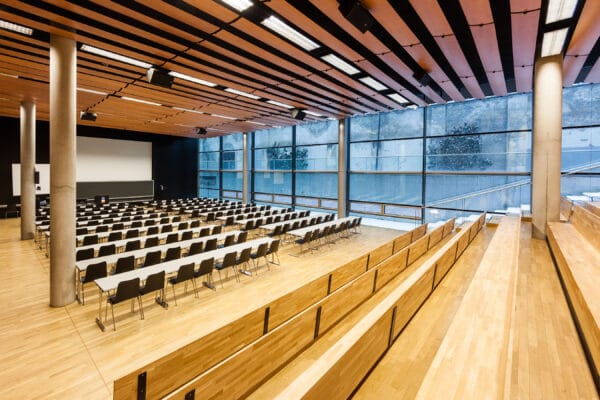
NAME:
SOWI - Aula
BUILDING:
SOWI
FLOOR:
0
TYPE:
Assembly Hall
CAPACITY:
450
ACCESS:
Only Participants
EQUIPMENT:
Beamer, PC, WLAN (Eduroam), Overhead, Flipchart, Blackboard, Sound System, Handicapped Accessible, Microphones, Light Installation

Rock avalanches like in Blatten can not be mitigated with structural measures but only with organizational measures, for which the prediction of the expected runout is crucial. While the reconstruction of rock avalanches is rather easy with an appropriate model, their prediction is still challenging due to uncertainties in the parameterization. The runout of the rock avalanche in Blatten is reconstructed with a Savage-Hutter model, achieving an areal match about 60 % regarding the complete envelope and about 80 % excluding the distal part of the run up. Additionally, the reconstruction with a simple Fahrböschung model achieves an areal match of almost 100 % including the distal part of the run up but overestimating the lateral spread. The only parameter needed for these models is the kinetic friction angle, which is determined by the estimated volume of 9000000 m3 to 19° using the empirical formula of Scheidegger, which also fits well to the geometric value estimated from the envelope. This reconstruction shows a promising path for future predictions that could overcome parameterization issues. Machine learning could analyze the kinetic friction angle and various covariates from past rock avalanches in order to predict values with probabilities of exceedance for parameterizing and predicting future rock avalanches. Assigning a probability of exceedance to the kinetic friction angle would enable a transformation from a deterministic to a probabilistic approach. Furthermore, several models such as the Savage-Hutter model and the Fahrböschung model could be combined in an model ensemble. Such an approach would combine statistical analyses with physical models and could contribute to robust predictions for the runout of rock avalanches in preliminary assessments.
We and use cookies and other tracking technologies to improve your experience on our website. We may store and/or access information on a device and process personal data, such as your IP address and browsing data, for personalised advertising and content, advertising and content measurement, audience research and services development. Additionally, we may utilize precise geolocation data and identification through device scanning.
Please note that your consent will be valid across all our subdomains. You can change or withdraw your consent at any time by clicking the “Consent Preferences” button at the bottom of your screen. We respect your choices and are committed to providing you with a transparent and secure browsing experience.