

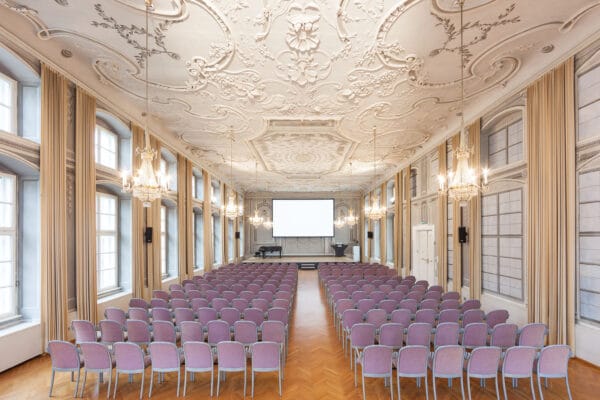
NAME:
Theologie - KLS
BUILDING:
Theologie
FLOOR:
2
TYPE:
Lecture Room
CAPACITY:
173
ACCESS:
Only Participants
EQUIPMENT:
Beamer, PC, WLAN (Eduroam), Overhead, Handicapped Accessible, LAN, Microphones, Light Installation, Sound System, Speaker Desk
Established over 40 years ago, Hohe Tauern National Park is one of Central Europe’s largest protected areas, spanning 1,856 km² across Carinthia, Salzburg, and Tyrol. It features a 1,213 km² core zone, where nature remains untouched, and a 643 km² buffer zone, allowing traditional land use. The park’s legal framework was finalized between 1981 and 1992, with IUCN Category II recognition granted in 2001 (Carinthia) and 2006 (Salzburg & Tyrol). Home to exceptional biodiversity, the park preserves high-altitude ecosystems, with over a third of Austria’s plant species and half of its vertebrates. Iconic species like bearded vultures, ibex, and golden eagles benefit from dedicated conservation efforts. The park’s zoning—from montane pastures to glacial peaks—ensures ecosystem integrity while integrating human activities. The Hohe Tauern National Park is accredited as a “regular site” by LTER-Austria (Long-Term Ecological Research Austria). This recognition enhances the park’s visibility and international networking within the European LTER network (eLTER) as it develops into a European Research Infrastructure (eLTER RI). Now the Hohe Tauern National Park is actively participating in the development of a joint LTSER (Long-Term Socio-Ecological Research) platform along the Austrian Central Alps, further advancing interdisciplinary research and ecological monitoring in the region.
We and use cookies and other tracking technologies to improve your experience on our website. We may store and/or access information on a device and process personal data, such as your IP address and browsing data, for personalised advertising and content, advertising and content measurement, audience research and services development. Additionally, we may utilize precise geolocation data and identification through device scanning.
Please note that your consent will be valid across all our subdomains. You can change or withdraw your consent at any time by clicking the “Consent Preferences” button at the bottom of your screen. We respect your choices and are committed to providing you with a transparent and secure browsing experience.