
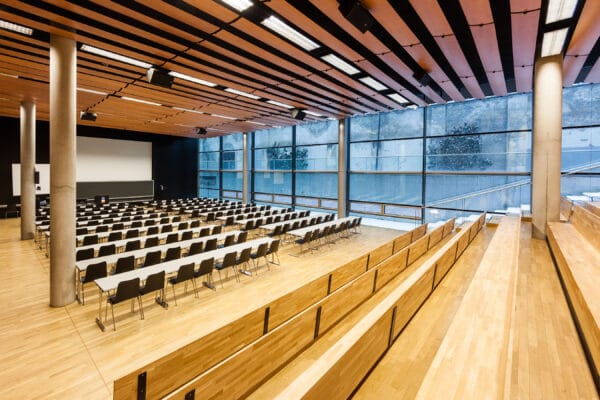
NAME:
SOWI - Aula
BUILDING:
SOWI
FLOOR:
0
TYPE:
Assembly Hall
CAPACITY:
450
ACCESS:
Only Participants
EQUIPMENT:
Beamer, PC, WLAN (Eduroam), Overhead, Flipchart, Blackboard, Sound System, Handicapped Accessible, Microphones, Light Installation
On May 28, 2025, at approximately 15:30 CEST, a 9-million-cubic-meter rock–ice avalanche detached from the Birch Glacier in the Lötschental valley, Switzerland. This event was preceded ten days earlier by a major landslide from a source area higher up in the valley, which impacted and covered a part of the Birch glacier. Concerns about the resulting instability of the glacier prompted a precautionary evacuation of the village of Blatten below, which was indeed partially destroyed by the May 28th ice-avalanche and caused one fatality. The avalanche’s runout exceeded predictive model forecasts. The event underscores the need for accurate runout prediction for complex mass movements.
To better understand the rock-ice avalanche dynamics, we use granular flow numerical modelling constrained by force histories inverted from seismic broadband data and the deposit extent and thickness. The simulations of landslide runout demonstrate that the force history can be reproduced with both a pure Coulomb and a μ(I) rheology. Notably, the successful Coulomb models require a low friction angle of 7o, lower than predicted by empirical volume-mobility relationships for a landslide of this size. The presence of substantial ice in the avalanche material may have contributed to this higher mobility. Furthermore, fully explaining the final deposit distribution may require additional late-stage processes that reduce internal friction, such as partial liquefaction. This slow-moving phase of motion would generate forces of lower magnitude and longer period than could be detectable in a seismic force history but is supported by the final deposit’s thickness distribution.
We and use cookies and other tracking technologies to improve your experience on our website. We may store and/or access information on a device and process personal data, such as your IP address and browsing data, for personalised advertising and content, advertising and content measurement, audience research and services development. Additionally, we may utilize precise geolocation data and identification through device scanning.
Please note that your consent will be valid across all our subdomains. You can change or withdraw your consent at any time by clicking the “Consent Preferences” button at the bottom of your screen. We respect your choices and are committed to providing you with a transparent and secure browsing experience.