
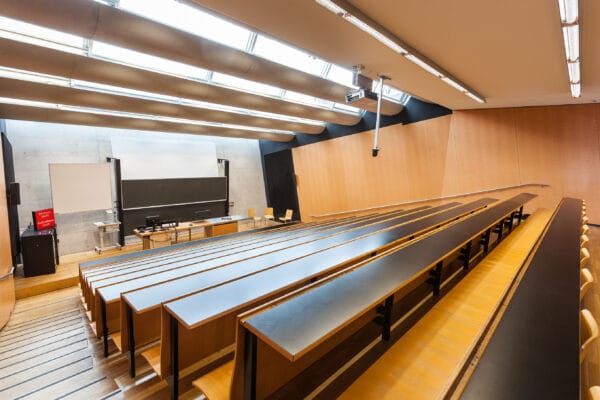
NAME:
SOWI - HS 1
BUILDING:
SOWI
FLOOR:
0
TYPE:
Lecture Hall
CAPACITY:
160
ACCESS:
Only Participants
EQUIPMENT:
Beamer, PC, WLAN (Eduroam), Overhead, Flipchart, Blackboard, Sound System, Handicapped Accessible, Microphones
Mountain ranges in cold regions are increasingly affected by climate change, with significant implications for water discharge, particularly in catchments where the cryosphere plays a key role. While the most pronounced changes are observed in summer, important shifts also occur in winter. Glaciers, ground ice, and other periglacial landforms contribute to wintertime aufeis formation by supplying subglacial and groundwater flow. Analyzing aufeis formation patterns provides valuable insights into hydrological and cryospheric changes in mountain catchments. This study investigates these changes in the Shä́r Ndü Chù (Duke River) catchment, a 654 km² watershed in the St. Elias Mountains (Yukon, Canada) with 9% glacier coverage. We document aufeis formation from 1984 to 2025 using Landsat and Sentinel-2 imagery, revealing both continuous and discontinuous formation trends depending on site-specific conditions. These trends are examined in relation to hydrometeorological variability, glacial dynamics, and the distribution of periglacial landforms, such as rock glaciers. Our results show that aufeis near glacier termini generally exhibit continuous formation trends, whereas aufeis located further downstream, fed by other sources, display greater variability. Some aufeis formations have ceased entirely, indicating a permanent shift in winter water supply. Meteorological factors alone do not fully explain the observed variations in aufeis formation. Instead, the differing formation patterns highlight complex hydrological changes in mountain catchments, driven by evolving winter water contributions from diverse landforms. By exploring the wintertime impacts of hydrological change in cold regions, our findings enhance understanding of water cycle dynamics in deglaciating catchments—an essential step in assessing the broader consequences of climate change in mountain environments.
We and use cookies and other tracking technologies to improve your experience on our website. We may store and/or access information on a device and process personal data, such as your IP address and browsing data, for personalised advertising and content, advertising and content measurement, audience research and services development. Additionally, we may utilize precise geolocation data and identification through device scanning.
Please note that your consent will be valid across all our subdomains. You can change or withdraw your consent at any time by clicking the “Consent Preferences” button at the bottom of your screen. We respect your choices and are committed to providing you with a transparent and secure browsing experience.