

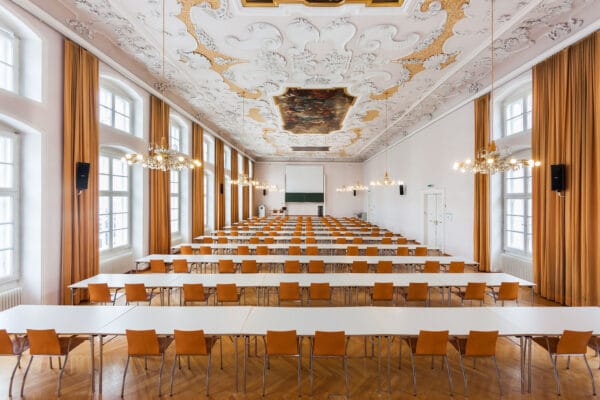
NAME:
Theologie - MS
BUILDING:
Theologie
FLOOR:
2
TYPE:
Lecture Room
CAPACITY:
108
ACCESS:
Only Participants
EQUIPMENT:
Beamer, PC, WLAN (Eduroam), Overhead, Flipchart, Blackboard, Handicapped Accessible, LAN, Microphones, Sound System
Community houses (“Case di Comunità” in Italian) in Alpine valleys represent an important spatial paradigm for social cohesion and cultural preservation in the contexts where they showcase vulnerability and fragility. The verticality of the terrain, which creates isolation and socio-economic challenges, has shaped distinct architectural responses to communal needs. The study focuses on secondary and dead-end valleys in North-East Italy, Trentino Region(TN), where these architectural artifacts serve as spatial hubs that moderate between these challenging landscapes and community life. In contrast to standardized urban typologies, Alpine community houses manifest a distinct architectural language that responds to topographical constraints while preserving vernacular building traditions. These structures disunite significantly from classic metropolitan models through their spatial articulation, which reinforces local identity, hosts essential services, and nurtures collective cultural practices. Their architectural expression maintains profound connections with the surrounding territory through a considered design approach that understands specific local needs with traditional building methodologies. A common feature of these structures is their spatial organization, reflecting an understanding of the morphological complexity of the Alpine terrain, where enclosed valleys and a challenging topography require a diversity of architectural solutions that demonstrate communal cohesion. Based on this framework, it becomes apparent that these structures’ adaptive spatial configurations serve multiple functions while maintaining cultural integrity, thus showing how architectural form is crucial to the survival of mountain communities in the face of contemporary challenges. The research reveals that, in line with the National Recovery and Resilience Plan (PNRR), these structures emerge as more than just service centers. Through architectural means, they represent a new interpretation of “social construction” and “generative welfare.” The investigation highlights their significance beyond mere service delivery, positioning them as key actors for territorial regeneration and social innovation in their context. The possible outcome is to define “Casa della Comunità” as an architectural prototype adaptable to different contexts designed to regenerate valleys into bonded communities, enhance social cohesion, and preserve cultural heritage in isolated areas.
We and use cookies and other tracking technologies to improve your experience on our website. We may store and/or access information on a device and process personal data, such as your IP address and browsing data, for personalised advertising and content, advertising and content measurement, audience research and services development. Additionally, we may utilize precise geolocation data and identification through device scanning.
Please note that your consent will be valid across all our subdomains. You can change or withdraw your consent at any time by clicking the “Consent Preferences” button at the bottom of your screen. We respect your choices and are committed to providing you with a transparent and secure browsing experience.