

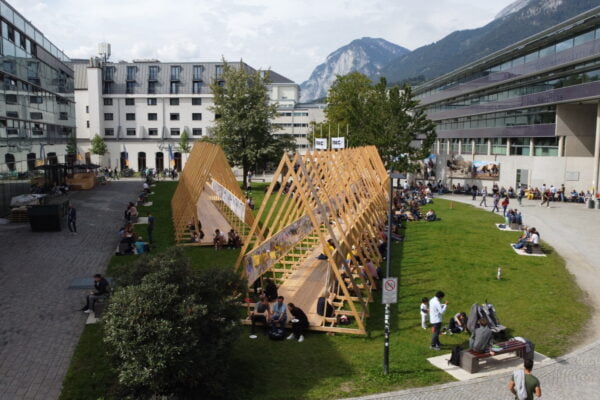
NAME:
SOWI - Garden
BUILDING:
SOWI
FLOOR:
0
TYPE:
Garden
CAPACITY:
2000
ACCESS:
Public Access
EQUIPMENT:
---
Mountains are sensitive to increases in air temperature because they cause a shift from snowfall to rainfall, resulting in a decrease in snow storage. This in turn affects the runoff regime, for example through more frequent snowmelt periods and increased winter runoff. Therefore, the question emerged of whether these changes could contribute to changes in catchment transit times and thus lead to an acceleration of the water cycle and changes in hydrological extremes, such as rain-on-snow (RoS) events. In this study, we quantified 1) whether the increasing number of partial snowmelt periods during winter affects the partitioning of the snowmelt water into soil and groundwater components, and 2) to assess the frequency and trends in RoS events and their runoff response. To investigate the above changes, we used long-term simulations from 68 mountain catchments in Czechia covering the period from 1965 to 2019, using a bucket-type catchment model. We analysed temporal trends in the fractions of fast (event) and slow (baseflow) runoff responses, calculated as monthly or seasonal fractions of the individual components to total runoff. The statistical significance of temporal trends was evaluated using the Mann-Kendall test. The elasticity index was calculated to describe how sensitive the fractions are to changes in SWE and snowmelt volume. The preliminary results indicate that snow-poor years are characterized by a higher fraction of fast-response runoff during the winter months. In contrast, years with high maximum SWE lead to higher groundwater recharge which also contributed to higher low flows during late spring and early summer. The changes in the fast response represented by RoS events showed large temporal and spatial differences in these events over the last five decades, with a RoS increase mainly at high elevations and a decrease at low elevations during spring. RoS events contributed by 3-32% to the total seasonal runoff. The observed trends reflect changes in climate and snow variables, with an increase in air temperature leading to more rainfall during the winter period, an overall decrease in snow storage and a shorter snow cover duration.
We and use cookies and other tracking technologies to improve your experience on our website. We may store and/or access information on a device and process personal data, such as your IP address and browsing data, for personalised advertising and content, advertising and content measurement, audience research and services development. Additionally, we may utilize precise geolocation data and identification through device scanning.
Please note that your consent will be valid across all our subdomains. You can change or withdraw your consent at any time by clicking the “Consent Preferences” button at the bottom of your screen. We respect your choices and are committed to providing you with a transparent and secure browsing experience.