NAME:
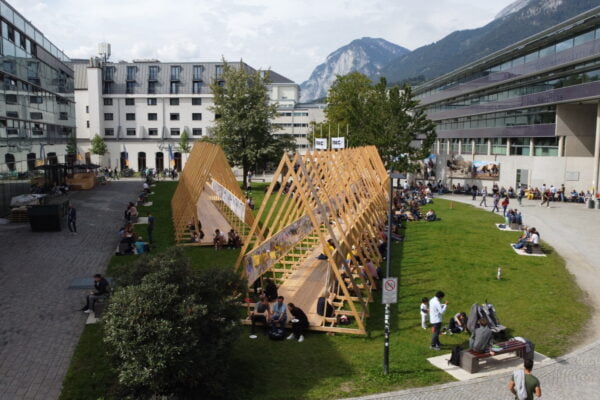
SOWI - Garden
BUILDING:
SOWI
FLOOR:
0
TYPE:
Garden
CAPACITY:
2000
ACCESS:
Public Access
EQUIPMENT:
---
The mountains that are and always will be. The mountains that are always becoming different. The speed of that differentiation is influenced by what people do and do not do on these mountains. Meadows being swallowed by forest. Forest being swallowed by bark beetle. What people do and do not do in faraway places seem to have no bearing on the glaciers retreating, the swelling of the lakes. Mountain landscapes have always forced humans to extract the quintessence of survival, to feel the extreme of being human and sharing life, sharing spaces with the more-than-human. Abundant work is being done to understand how landscape and place play a critical role in earth-system stewardship even (or especially) in a hyper-connected world, characterized by dispossession, disconnection, injustice, and struggle. We suggest that much of these issues are exacerbated through binaries of here/there, place-based/global, science/practice. Here, we explore how participatory research methods—specifically mutually inspiring auto-ethnographic fictional writing—can foster deeper connections between humans and other-than-humans by embracing in-between spaces/liminality and thereby moving away from dichotomous thinking by blending nature-based experiences with creative collaboration. Through our duoethnographic study, I/we reflect on our transformative relationships with mountain spaces and co-create stories that intertwine reality with imagination. Maria’s “mountain ghosts” and Jamila’s becoming with the mythical “Palfner Nixe” (of an alpine lake) illustrate how creative texts enable us to explore the fluid, interconnected nature of our relationship with mountain landscapes. By writing together, we dissolve boundaries between personal experience and the larger, living landscape, allowing the mountain to become an active participant in our process of discovering longing and belonging. Our writing facilitates a deeper empathy for the mountain world, where human and more-than-human are intertwined and constantly becoming through more-than-physical paths. Through this approach, we challenge traditional research paradigms that compartmentalize humans and nature, demonstrating how creative duoethnography can embrace more holistic, evolving relationships with the world. By actively participating with the landscape through creative, co-authored narratives, we experience meaningful change in how we understand and care for the world around us.
We and use cookies and other tracking technologies to improve your experience on our website. We may store and/or access information on a device and process personal data, such as your IP address and browsing data, for personalised advertising and content, advertising and content measurement, audience research and services development. Additionally, we may utilize precise geolocation data and identification through device scanning.
Please note that your consent will be valid across all our subdomains. You can change or withdraw your consent at any time by clicking the “Consent Preferences” button at the bottom of your screen. We respect your choices and are committed to providing you with a transparent and secure browsing experience.