
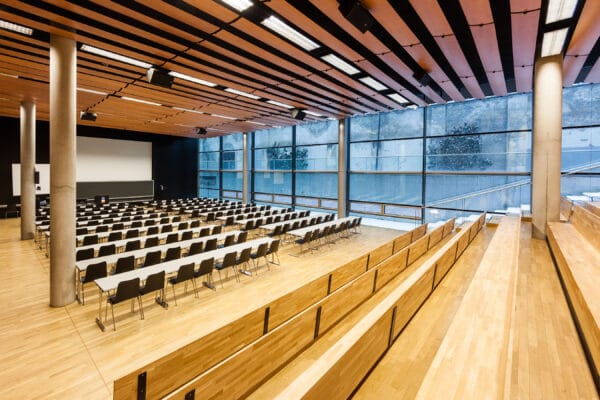
NAME:
SOWI - Aula
BUILDING:
SOWI
FLOOR:
0
TYPE:
Assembly Hall
CAPACITY:
450
ACCESS:
Only Participants
EQUIPMENT:
Beamer, PC, WLAN (Eduroam), Overhead, Flipchart, Blackboard, Sound System, Handicapped Accessible, Microphones, Light Installation
The glacier collapse and avalanche disaster on 28 May 2025 in Blatten raised a range of discussions in the scientific community and in media and policy about the potential effect and role of (anthropogenic) climate change.
Here we provide a framework how to perform and assess the attribution of the glacier collapse to anthropogenic climate change, and what this implies for the case of Blatten.
We ground our approach on concepts developed within the IPCC AR5 and AR6, where different drivers of change are evaluated, and the contribution of climate change to an observed change is assessed against other non-climatic factors. For a case like Blatten and Birch glacier, it is important to consider that we’re dealing with impact attribution, which is different from attribution in the field of atmospheric processes (e.g. heat waves, heavy rainfall, etc).
Furthermore, it is important to distinguish different time scales, and their effect on attribution. Specifically, first, we have here long-term, decadal-scale atmospheric warming that has effects on the cryosphere and high mountain systems, and eventually on slope stability. Second, we can evaluate whether short-term weather conditions could also have had an effect on rock slope and glacier instability. Long-term (decadal-scale) warming is typically more confidently attributed to anthropogenic climate change than short-term (days to weeks) weather conditions.
Decadal-scale warming has had a strong effect on processes that influenced the rock slope instabilities at Kleines Nesthorn and then on the glacier collapse. First, warming led to downwasting of Birch glacier, which in turn had a debuttressing effect on the northern slope of Kleines Nesthorn. Second, warming had an effect on permafrost through several processes that overall resulted in a destabilization of the rock slope. Third, warming also affected perennial firn and snow in the rock slopes (and couloirs), and their loss results in a more direct penetration of heat into bedrock and destabilization of surface rock.
Finally, we emphasize that attribution statements need to be made carefully, with precise wording that reflects that state of scientific evidence and understanding.
We and use cookies and other tracking technologies to improve your experience on our website. We may store and/or access information on a device and process personal data, such as your IP address and browsing data, for personalised advertising and content, advertising and content measurement, audience research and services development. Additionally, we may utilize precise geolocation data and identification through device scanning.
Please note that your consent will be valid across all our subdomains. You can change or withdraw your consent at any time by clicking the “Consent Preferences” button at the bottom of your screen. We respect your choices and are committed to providing you with a transparent and secure browsing experience.