
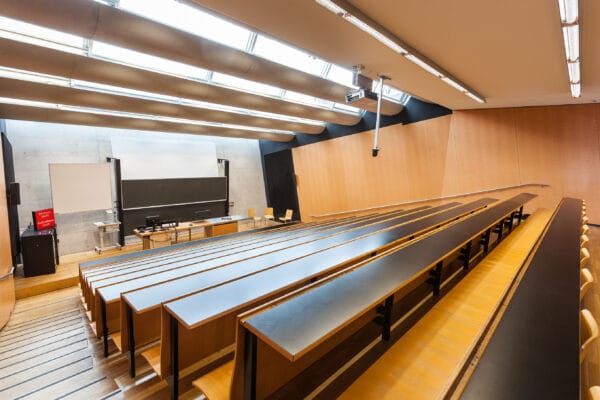
NAME:
SOWI - HS 1
BUILDING:
SOWI
FLOOR:
0
TYPE:
Lecture Hall
CAPACITY:
160
ACCESS:
Only Participants
EQUIPMENT:
Beamer, PC, WLAN (Eduroam), Overhead, Flipchart, Blackboard, Sound System, Handicapped Accessible, Microphones
Snow sublimation remains poorly quantified in the high-elevation European Alps, creating significant uncertainties in snow ablation partitioning. Specifically, the balance between sublimation losses to the atmosphere and snowmelt infiltration into the subsurface remains unclear. Accurately constraining this partitioning is essential for effective water management in downstream basins.
Here, we present snow sublimation estimates at three alpine sites in Davos, Switzerland, using eddy covariance-derived latent heat fluxes and stable water isotope (δ¹⁸O and δ²H) measurements from snow surface samples during the 2025 winter. These sites offer unique accessibility, enabling high-temporal-resolution snowpack sampling, from sub-diurnal to weekly time scales. This study improves our understanding of sublimation in the Alps by assessing to what extent fractionation patterns in stable water isotopes of surface snowpack can serve as a reliable proxy for estimating snow sublimation.
We and use cookies and other tracking technologies to improve your experience on our website. We may store and/or access information on a device and process personal data, such as your IP address and browsing data, for personalised advertising and content, advertising and content measurement, audience research and services development. Additionally, we may utilize precise geolocation data and identification through device scanning.
Please note that your consent will be valid across all our subdomains. You can change or withdraw your consent at any time by clicking the “Consent Preferences” button at the bottom of your screen. We respect your choices and are committed to providing you with a transparent and secure browsing experience.