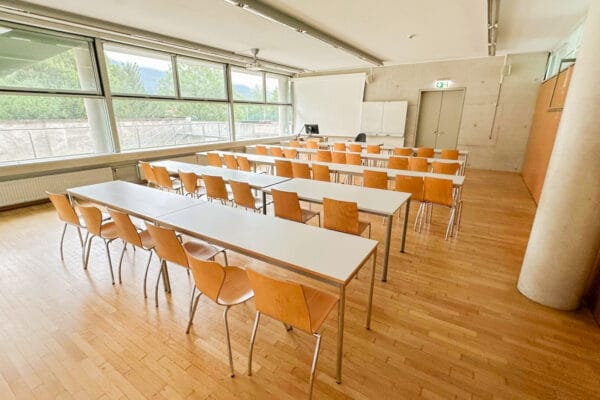
NAME:
SOWI - SR 3
BUILDING:
SOWI
FLOOR:
1
TYPE:
Seminar Room
CAPACITY:
35
ACCESS:
Only Participants
EQUIPMENT:
Beamer, PC, WLAN (Eduroam), Overhead, Flipchart, Blackboard, Handicapped Accessible, LAN
Analysing multi-hazard events is inherently complex, often involving a vast array of processes with varying degrees of interdependency. Sediment connectivity, increasingly investigated in natural hazard and risk research for its substantial influence on hazard occurrence and characterization, remains largely underexplored in multi-hazard contexts – perhaps due to the added complexity of integration. Extensive data requirements, along with its non-uniformity and scarcity – create further challenges for systematic analysis. By introducing a holistic framework, this study aims to systematically integrate sediment connectivity into multi-hazard analysis, providing a comprehensive foundation for future research in this domain. Our approach deconstructs complex multi-hazard events into unitary process segments to enable a systematic assessment of their roles in hazard propagation from a sediment connectivity perspective. The data-agnostic design of the framework allows analysing hazard events with limited and non-uniform sets of data. We make use of a fuzzy-logic based framework to derive weights of sediment connectivity and probabilities to the deconstructed process-segments for event-tree analysis. This allows scenario-based comparisons of event propagation, such as assessing how protective measures or extreme environmental conditions might have influenced process dynamics and the event as a whole. The modular and adaptive design is the key strength of this approach, providing a structured yet flexible method for holistic analysis of multi-hazard events. Its interoperable and adaptive framework allows seamless integration of fragmented data sources, ensuring meaningful analysis even with incomplete and non-uniform datasets. The primary objective of this study was to not only establish a foundation for holistic multi-hazard analysis, but also to encourage further research on sediment connectivity and its role in multi-hazard dynamics.
We and use cookies and other tracking technologies to improve your experience on our website. We may store and/or access information on a device and process personal data, such as your IP address and browsing data, for personalised advertising and content, advertising and content measurement, audience research and services development. Additionally, we may utilize precise geolocation data and identification through device scanning.
Please note that your consent will be valid across all our subdomains. You can change or withdraw your consent at any time by clicking the “Consent Preferences” button at the bottom of your screen. We respect your choices and are committed to providing you with a transparent and secure browsing experience.