

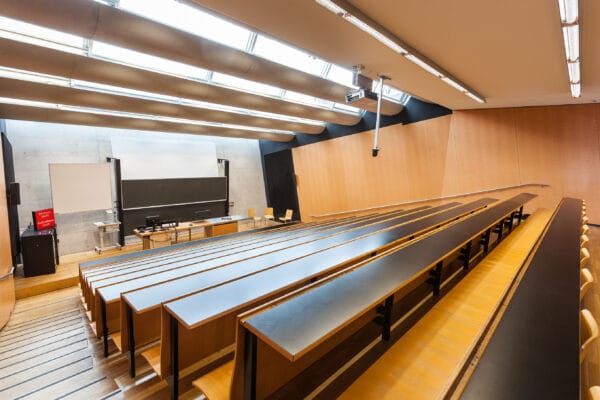
NAME:
SOWI - HS 3
BUILDING:
SOWI
FLOOR:
0
TYPE:
Lecture Hall
CAPACITY:
140
ACCESS:
Only Participants
EQUIPMENT:
Beamer, PC, WLAN (Eduroam), Overhead, Blackboard, Sound System, Microphones, Handicapped Accessible
Snow cover is a primary agent of the diversity of microclimates in alpine and cold ecosystems, and also of the offset between macro and microclimate. Nonetheless, from the available instrumentation, an accurate computation of snow presence relevant at the scale of biotic communities can be a challenge by itself. Moreover, the snowpack insulating properties during the deep winter and water and nutrient release during the snowmelt are major ecological implications of the snow cover which are even more challenging to grasp from snow presence/absence data. In mild cold ecosystems, the macroclimate is less extreme than in high latitude and altitude areas and the snow cover is more susceptible to variability in space and time. They are then likely to be appropriate systems to explore the possibility of snow cover derivates from microclimate time series and associate winter parameters relevant for larger scale modeling. Here, we used a microclimate monitoring design installed during three consecutive winters in a tree wells system of the natural coniferous forests in the Šumava Mts., Czech Republic, to test the capture capabilities of simple temperature time series. Tree wells are voids of loose snow around the trunk of trees, especially spruce, which exhibit specific winter microclimate on the forest floor. The design included TMS dataloggers that measured temperature at 15, 0 and -8 cm and soil moisture at different distances from a tree, one out of the tree canopy influence, and one at 200 cm height as well as camera traps to record the snowpack features. First, with the visual inspection of images, we tested the accuracy of the snow detection function proposed in myClim package. Second, by comparing the patterns recorded by the different sensors for three interannually variable snow regimes on contrasted microhabitats, we explored to what extent slighter changes in the snowpack features than presence/absence can be captured in near ground temperature time series.
We and use cookies and other tracking technologies to improve your experience on our website. We may store and/or access information on a device and process personal data, such as your IP address and browsing data, for personalised advertising and content, advertising and content measurement, audience research and services development. Additionally, we may utilize precise geolocation data and identification through device scanning.
Please note that your consent will be valid across all our subdomains. You can change or withdraw your consent at any time by clicking the “Consent Preferences” button at the bottom of your screen. We respect your choices and are committed to providing you with a transparent and secure browsing experience.