

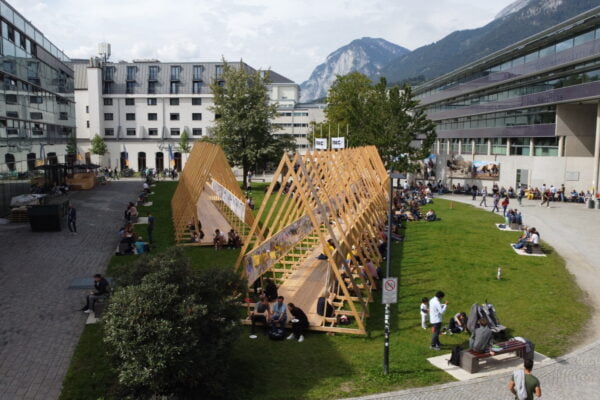
NAME:
SOWI - Garden
BUILDING:
SOWI
FLOOR:
0
TYPE:
Garden
CAPACITY:
2000
ACCESS:
Public Access
EQUIPMENT:
---
BACKGROUND
Materials and components that are used in alpine regions are exposed to extreme environmental conditions such as sub-zero temperatures and high humidity. These factors influence the mechanical properties of the materials and can significantly impair their long-term use.
OBJECTIVES
The aim of this work is to investigate the mechanical properties and behavior of additively manufactured polymer objects in different temperature ranges. Based on the knowledge gained, it should be possible to select materials that are suitable for long-term use under difficult conditions.
METHODS
The present work focusses on the investigation of three materials: acrylonitrile-styrene-acrylate (ASA), polylactide (PLA) and polyethylene terephthalate, glycol-modified (PET-G). Standardized test specimens were produced under reproducible conditions using additive manufacturing. Some of the samples were stored in demineralized water at a constant 20°C for 168 hours (1 week). All samples were then subjected to tensile testing at -17°C, 0°C and +21°C.
RESULTS
It was found that the water absorption for the materials analyzed differed greatly in some cases, with PET-G showing the highest water absorption. With decreasing temperatures, a tendency towards increasing tensile strength was observed. The evaluation of the modulus of elasticity at different temperatures showed only minor changes. Differences were mainly found in comparison to the values given in the data sheets, with PET-G also showing the greatest changes here.
CONCLUSION
Additive manufacturing offers a wide range of possibilities for designing housings, brackets and connecting elements. By selecting suitable materials, resource-saving production can also be realized.
Two key statements that can be made are
– Low temperatures (-17°C) have no negative influence on tensile strength.
– The choice of material should depend on the requirements, i.e. ASA should be chosen for structurally stressed components (e.g. brackets for weather stations) and PLA for the housing (due to the lower water absorption).
We and use cookies and other tracking technologies to improve your experience on our website. We may store and/or access information on a device and process personal data, such as your IP address and browsing data, for personalised advertising and content, advertising and content measurement, audience research and services development. Additionally, we may utilize precise geolocation data and identification through device scanning.
Please note that your consent will be valid across all our subdomains. You can change or withdraw your consent at any time by clicking the “Consent Preferences” button at the bottom of your screen. We respect your choices and are committed to providing you with a transparent and secure browsing experience.