
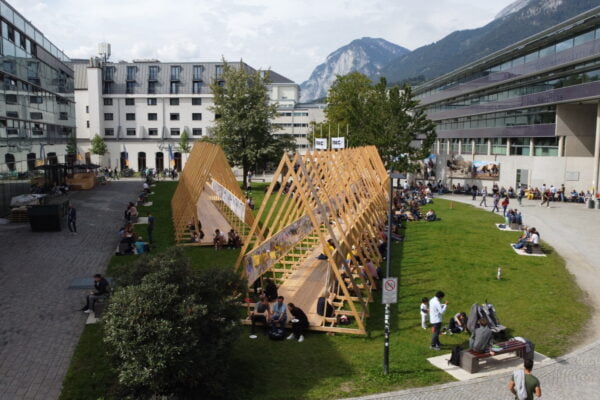
NAME:
SOWI - Garden
BUILDING:
SOWI
FLOOR:
0
TYPE:
Garden
CAPACITY:
2000
ACCESS:
Public Access
EQUIPMENT:
---
Despite the established link between the presence of bats in mountainous regions and water availability, research on the role of high-elevation lakes for bats remains limited. Moreover, few studies investigate these lakes not only as water sources but also as potential feeding areas with a high availability of insect prey. Our study seeks to address this gap by exploring the dual role of natural high-altitude alpine lakes for bats, as a water source and a rich trophic resource. Six natural alpine lakes at an elevation between 2,368m and 2,805m were selected as study areas in the Gran Paradiso National Park, Italy. Each lake was paired with a control site under similar environmental conditions, situated at least 500m from the shore of the reference lake or other lakes. The field season consisted of three monitoring sessions, one per month, from July to September 2024. At each study site, both lake and control area, a bat detector was placed for three consecutive nights per session. At the same time, three sticky traps for flying insect were placed on 1.2m poles at 15m from the bat detectors at each site. To assess emerging insect population, three floating emergence traps were placed on the surface of the lakes on a 50cm water column, secured with wires, to collect flying insects emerging. Both types of insect traps remained in place for about 72 hours for each session. Water and air temperature and other environmental parameters were acquired. Finally, all recorded bat sequences were manually identified using software and assessed for the presence of feeding activity. A total of 108 recording nights were acquired, resulting in 9,669 bat sequences. Furthermore, 52 samples were collected from floating traps and 107 from sticky traps. Using GLMMs, bioacoustics data show a significant increase in bat activity and feeding activity near lakes, suggesting that alpine lakes are used by bats not only as water sources but also as important feeding areas. In addition, bat activity was significantly influenced by altitude and temperature.
We and use cookies and other tracking technologies to improve your experience on our website. We may store and/or access information on a device and process personal data, such as your IP address and browsing data, for personalised advertising and content, advertising and content measurement, audience research and services development. Additionally, we may utilize precise geolocation data and identification through device scanning.
Please note that your consent will be valid across all our subdomains. You can change or withdraw your consent at any time by clicking the “Consent Preferences” button at the bottom of your screen. We respect your choices and are committed to providing you with a transparent and secure browsing experience.