

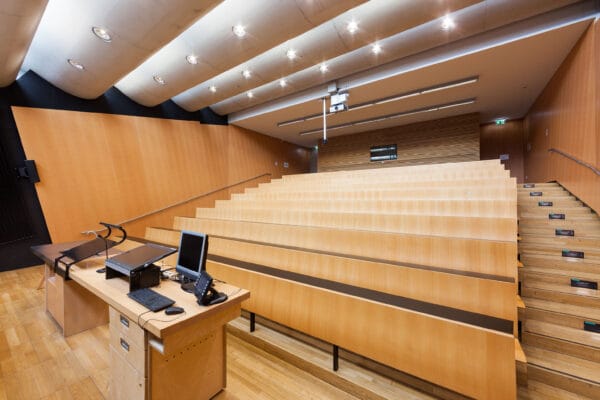
NAME:
SOWI - HS 2
BUILDING:
SOWI
FLOOR:
0
TYPE:
Lecture Hall
CAPACITY:
80
ACCESS:
Only Participants
EQUIPMENT:
Beamer, PC, WLAN (Eduroam), Overhead, Flipchart, Blackboard, Sound System, Handicapped Accessible, Light Installation
Mountain precipitation is the key driver of the Third Pole water cycle, which provides valuable water resources for millions of people living in the region and its surroundings. However, mountain precipitation can also be a key trigger for natural hazards, such as avalanches, floods, and landslides, leading to a large number of casualties and economic losses. Hence, it is important to understand precipitation patterns, dynamics and corresponding atmospheric processes at different scales (ranging from the valley scale to the synoptic scale), which remains, however, challenging due to the extreme topography and the limited availability of high-altitude precipitation measurements and well-validated high-resolution precipitation datasets.
To address this challenge, we use the numerical atmospheric Weather Research & Forecasting model (WRF) version 4.6.1. We apply WRF with three different nested model domains, with horizontal grid spacings of 9, 3, and 1 km, respectively. The 9 km domain covers an area extending from the Caspian Sea in the west to the western Pacific Ocean in the east, capturing remote atmospheric processes that potentially can influence the Third Pole. The 3 km domain covers the Third Pole region, and the 1 km domains cover transects over two meteorological contrasting regions in the Himalayas (Langtang) and the Pamir (Fedchenko and adjacent valleys). We evaluate the model outcomes by comparisons to gridded outputs derived from existing WRF-based datasets, such as the High Asia Refined analysis version 2 (HAR2), satellite-based datasets (e.g. IMERG-GPM), and high-altitude observational data obtained from automatic weather stations, pluviometers, and tipping buckets. The model outputs aim to contribute to a better understanding of high-altitude precipitation patterns, dynamics, and corresponding atmospheric processes in the Third Pole region.
We and use cookies and other tracking technologies to improve your experience on our website. We may store and/or access information on a device and process personal data, such as your IP address and browsing data, for personalised advertising and content, advertising and content measurement, audience research and services development. Additionally, we may utilize precise geolocation data and identification through device scanning.
Please note that your consent will be valid across all our subdomains. You can change or withdraw your consent at any time by clicking the “Consent Preferences” button at the bottom of your screen. We respect your choices and are committed to providing you with a transparent and secure browsing experience.