

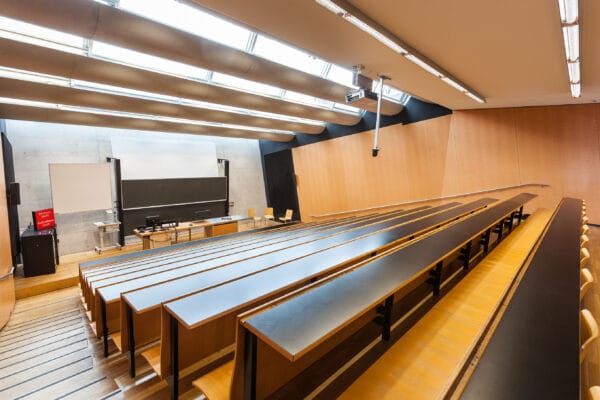
NAME:
SOWI - HS 1
BUILDING:
SOWI
FLOOR:
0
TYPE:
Lecture Hall
CAPACITY:
160
ACCESS:
Only Participants
EQUIPMENT:
Beamer, PC, WLAN (Eduroam), Overhead, Flipchart, Blackboard, Sound System, Handicapped Accessible, Microphones
Climate change in High Mountain Asia (HMA) is largely uncertain because the lack of local observations does not allow a proper estimation of long-term trends. The complex topography induces marked heterogeneities of the atmospheric variables in an area under the influence of both the Asian monsoons and the Western disturbances, two circulation patterns that show considerable variability from daily to decadal timescales. It is therefore challenging to simulate the climate variability in HMA. The ongoing retreat of glaciers observed in the Southern Himalayas suggests a significant warming signal, since there is no clear trend of precipitation in this area. The relative stability of the glaciers located on the western part of HMA observed over the last decades, with some glaciers showing even positive mass balance in the Karakoram region is more difficult to interpret. To explain this “Karakoram anomaly”, several physical processes have been suggested, including cloud changes, summer cooling and winter snowfall increase. However, there is no consensus on the exact causes of this phenomenon and their relative contributions, including the role of anthropogenic influence. A general increase in precipitation is expected in this area, in relation to the warming associated with greenhouse gases that favour higher moisture rates in the atmosphere. This effect contrasts with the increase in aerosol concentrations observed in the Indian subcontinent that induces a local cooling and a weakening of the monsoon systems. In this study, a large set of observational and model datasets is used to investigate dynamical versus thermodynamic atmospheric changes in this area. Trends are decomposed to disentangle atmospheric circulation changes from thermodynamic signals, with their respective imprints in temperature and precipitation. The method is first applied to observations to directly interpret the atmospheric trends over the last decades as well as their potential impacts on the cryosphere. Then, climate simulations including and excluding anthropogenic forcings, as well as single forcing experiments considering separately aerosols and greenhouse gases (DAMIP) are used to highlight their signature in the climate of HMA.
We and use cookies and other tracking technologies to improve your experience on our website. We may store and/or access information on a device and process personal data, such as your IP address and browsing data, for personalised advertising and content, advertising and content measurement, audience research and services development. Additionally, we may utilize precise geolocation data and identification through device scanning.
Please note that your consent will be valid across all our subdomains. You can change or withdraw your consent at any time by clicking the “Consent Preferences” button at the bottom of your screen. We respect your choices and are committed to providing you with a transparent and secure browsing experience.