
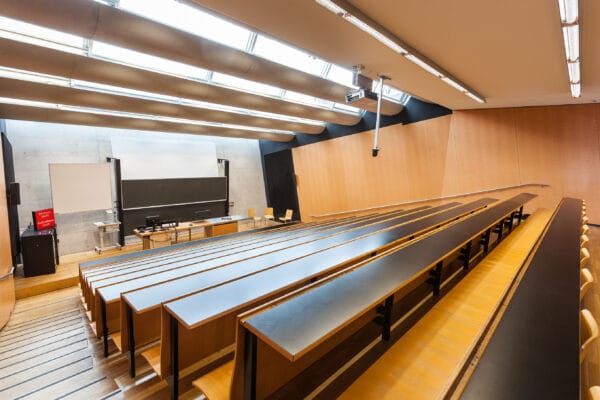
NAME:
SOWI - HS 1
BUILDING:
SOWI
FLOOR:
0
TYPE:
Lecture Hall
CAPACITY:
160
ACCESS:
Only Participants
EQUIPMENT:
Beamer, PC, WLAN (Eduroam), Overhead, Flipchart, Blackboard, Sound System, Handicapped Accessible, Microphones
The Himalayan-Karakoram (HK) region serves as a vital freshwater resource for over one billion people across the Indus, Ganges, and Brahmaputra River basins. Climate warming is expected to severely impact the cryosphere, particularly glacier and snowmelt dynamics, raising concerns for long-term water sustainability in this vulnerable region. An accurate representation of the cryosphere in hydrological models is therefore crucial to understanding these dynamics and predicting future water availability. However, these models face challenges related to meteorological forcing and calibration due to sparse data and complex topography. To better address these challenges, the Global Glacier Evolution Model (GloGEM) is one-way coupled with the flexible hydrological modelling framework Raven. The coupled glacio-hydrological model is applied to glaciated catchments in the Himalayan Mountain range, focusing on contributions of glacier and snowmelt to streamflow. Simulations with the coupled model improve both the magnitude and timing of glacier melt. These improvements affect the calibration of model parameters, particularly those related to snow, which previously compensated for deficiencies in the modelled glacier melt, altering snowmelt contributions to streamflow. In a second step, high-resolution snow cover products are used for multi-objective calibration to better define the snow parameter space and further improve simulations of snowmelt contributions to streamflow. These modelling and calibration strategies are employed to robustly assess shifts in glacier and snowmelt contributions under future climate scenarios. Ultimately, the goal is to enhance future predictions of water availability in the data-scarce Himalayan Mountain range, providing more reliable insights for long-term water resource management.
We and use cookies and other tracking technologies to improve your experience on our website. We may store and/or access information on a device and process personal data, such as your IP address and browsing data, for personalised advertising and content, advertising and content measurement, audience research and services development. Additionally, we may utilize precise geolocation data and identification through device scanning.
Please note that your consent will be valid across all our subdomains. You can change or withdraw your consent at any time by clicking the “Consent Preferences” button at the bottom of your screen. We respect your choices and are committed to providing you with a transparent and secure browsing experience.