
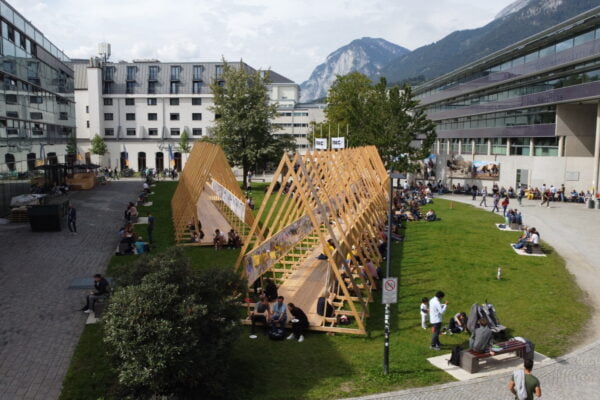
NAME:
SOWI - Garden
BUILDING:
SOWI
FLOOR:
0
TYPE:
Garden
CAPACITY:
2000
ACCESS:
Public Access
EQUIPMENT:
---
The Himalayan region is undergoing profound environmental changes, driven by climate change, deforestation, and socio-economic pressures. Forests, as critical ecological assets, are increasingly under stress, facing biodiversity loss, ecosystem degradation, and heightened disaster risks. Addressing these challenges requires more than scientific understanding—it necessitates actionable governance frameworks that integrate science, policy, and civil society engagement. However, existing governance structures often struggle to translate scientific research into policy implementation, leaving mountain communities and ecosystems vulnerable.
This paper examines how a robust science-policy interface can bridge the gap between research and governance to foster transformative action in the Himalayas. It explores the role of participatory governance models, adaptive policy frameworks, and civil society engagement in addressing ecological and socio-political challenges. By analyzing current governance mechanisms, the study identifies key gaps and opportunities for enhancing sustainable forest management and disaster risk reduction in mountain regions.
Drawing on case studies from the Himalayan landscape, the paper highlights successful models where scientific insights have influenced policy decisions and grassroots interventions. It underscores the need for inclusive, multi-stakeholder approaches to create adaptive, context-specific solutions that strengthen ecosystem resilience. Integrating traditional ecological knowledge with contemporary scientific advancements can enhance decision-making processes, ensuring that governance structures remain responsive to the evolving environmental challenges of mountain ecosystems.
For sustainable mountain development, policy must shift from reactive approaches to proactive governance strategies that are science-driven and community-centric. By fostering collaboration between researchers, policymakers, and civil society, we can develop holistic solutions that secure ecological integrity and socio-economic well-being. Strengthening institutional mechanisms and mainstreaming science-based policies into governance structures are essential steps toward a resilient and sustainable Himalayan future.
We and use cookies and other tracking technologies to improve your experience on our website. We may store and/or access information on a device and process personal data, such as your IP address and browsing data, for personalised advertising and content, advertising and content measurement, audience research and services development. Additionally, we may utilize precise geolocation data and identification through device scanning.
Please note that your consent will be valid across all our subdomains. You can change or withdraw your consent at any time by clicking the “Consent Preferences” button at the bottom of your screen. We respect your choices and are committed to providing you with a transparent and secure browsing experience.