

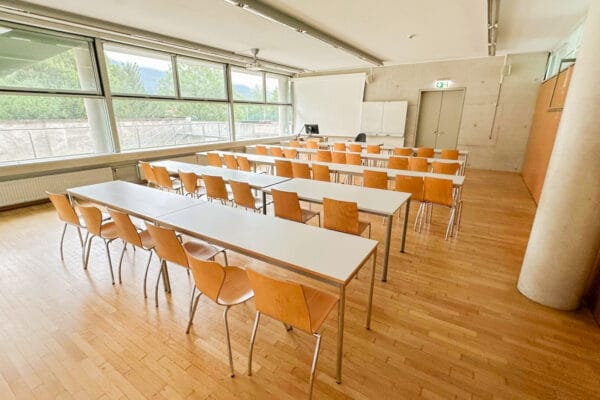
NAME:
SOWI - SR 3
BUILDING:
SOWI
FLOOR:
1
TYPE:
Seminar Room
CAPACITY:
35
ACCESS:
Only Participants
EQUIPMENT:
Beamer, PC, WLAN (Eduroam), Overhead, Flipchart, Blackboard, Handicapped Accessible, LAN
Mountain regions are warming faster than the global average, resulting in a higher frequency and magnitude of extreme hazard events. These changes, combined with socio-demographic and economic dynamics in mountain communities, affect vulnerability and exposure to natural hazards for both residents and visitors, such as tourists. The interactions between biophysical and human factors drive hazard risk, either reduce (e.g. through appropriate adaptation measures) or increase if mitigation efforts are too narrowly focused. While some scientific communities have adopted integrated approaches to studying hazard risk in coupled socio-ecological systems, a comprehensive and dynamic integration of both geomorphic and human aspects is still lacking. Additionally, many studies fail to adequately incorporate the concepts of learning, co-evolution, and social change. Complexity sciences and the school of Social Ecology provide valuable frameworks for understanding these dynamics, emphasizing the importance of societal responses to short-term challenges and long-term stressors in maintaining socio-ecological resilience. The theory of complex adaptive systems views learning, adaptation, and societal change as ongoing processes within these systems. The concept of the “colonization of natural ecosystems” highlights the continuous interventions of social systems into natural systems and their feedback. By combining these approaches, we can create a conceptual framework for explaining the evolution of risks. This framework forms the basis for modeling tools that are place-based, capable of capturing emergent phenomena, and able to address risk cascades and multi-hazards. This presentation builds on a conceptual model that explores risk and resilience in mountain communities and lays the foundation for integrating cellular automata and agent-based models into a numerical framework. This integrated modeling approach enhances our understanding of the factors, relationships, and interventions within coupled socio-ecological systems in mountain environments. Such frameworks provide crucial insights for decision-makers addressing natural hazards risks in increasingly uncertain and changing contexts.
We and use cookies and other tracking technologies to improve your experience on our website. We may store and/or access information on a device and process personal data, such as your IP address and browsing data, for personalised advertising and content, advertising and content measurement, audience research and services development. Additionally, we may utilize precise geolocation data and identification through device scanning.
Please note that your consent will be valid across all our subdomains. You can change or withdraw your consent at any time by clicking the “Consent Preferences” button at the bottom of your screen. We respect your choices and are committed to providing you with a transparent and secure browsing experience.