
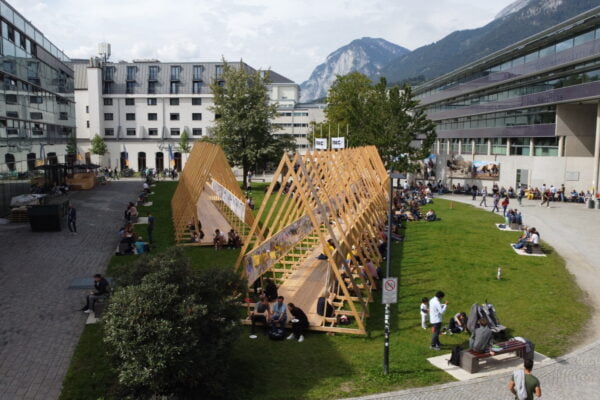
NAME:
SOWI - Garden
BUILDING:
SOWI
FLOOR:
0
TYPE:
Garden
CAPACITY:
2000
ACCESS:
Public Access
EQUIPMENT:
---
Over the last few decades, the increase in high-intensity forest fires that are difficult to control and the growing risk of fires in no originally fire-prone areas have given rise to concern among forest managers. In addition to the high mortality of trees, leaving a significant number of standing burnt stems, the structural damage caused by fire can vary from a reduction in the volume of the crown to the partial destruction of the root system, through to carbonisation of the wood of standing stems. On a finer scale, the mechanical properties of stems following a forest fire are poorly reported. However, the impact of heat treatment on wood properties is better known. Associated with a loss of mass, treated wood will show improved material hardness and durability over time, but also greater vulnerability to impact and a reduction in modulus of rupture, demonstrating a potential alteration in the mechanical properties of the stem. To quantify the impact of fire on the protective effect against rockfalls, current used models describe the protective effect of a forest as a function of stem density (i.e. probability of impact) and the ability of trees to dissipate energy on impact with a block (Ediss). However, these models were calibrated on healthy trees, implying homogeneous wood properties in the tested scenarios. This work therefore aims to estimate the maximum energy dissipation capacity of burnt trees in order to assess the protective effect of a forest after a fire. To do so, we proposed a new equation to compute Ediss at individual scale. The calibration is conducted through laboratory tests on a series of green and artificially burnt stems. In parallel, we conducted a case study using stems sampled in Bitsch forest (Wallis, CH), where the forest suffered an intense and uncontrollable forest fire in July 2023. Finally, the impact of the new Ediss values on the protective effect against rockfall of the forest stand was quantified using RockyFor3D software.
We and use cookies and other tracking technologies to improve your experience on our website. We may store and/or access information on a device and process personal data, such as your IP address and browsing data, for personalised advertising and content, advertising and content measurement, audience research and services development. Additionally, we may utilize precise geolocation data and identification through device scanning.
Please note that your consent will be valid across all our subdomains. You can change or withdraw your consent at any time by clicking the “Consent Preferences” button at the bottom of your screen. We respect your choices and are committed to providing you with a transparent and secure browsing experience.