

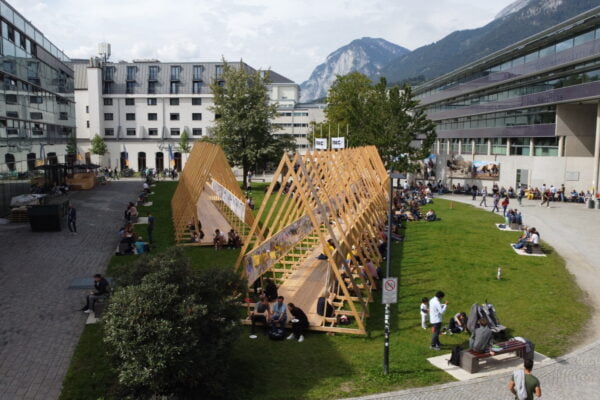
NAME:
SOWI - Garden
BUILDING:
SOWI
FLOOR:
0
TYPE:
Garden
CAPACITY:
2000
ACCESS:
Public Access
EQUIPMENT:
---
Climate change is driving significant shifts in mountain ecosystems, with alpine regions experiencing vegetation changes through mechanisms such as colonization by pioneer species, grassland development, shrubification, and tree line advancement. These processes, collectively known as mountain greening, can alter key hydrological dynamics by influencing aspects like infiltration, water retention, and evapotranspiration. As snow and ice storages decline under global warming, understanding how different greening mechanisms impact hydrology is crucial for predicting future water supply from mountain catchments.
To investigate how mountain vegetation changes could affect hydrology, we established 40 vegetation plots in the alpine Meretschi Catchment (6.2 km2) in Switzerland in five vegetation classes: bare, pioneer, grass, dwarf shrubs and larger shrubs/forest. At each plot we measured soil temperature and soil moisture with TOMST-TMS4 loggers at 15-minute intervals over the period 2023-2024. In addition, we collected and derived data on plot species composition, soil characteristics and topography. Using uni- and multivariate statistical analyses (Structural equation modelling) , we investigated interactions between vegetation, soil properties, topography, microclimate and hydrology (soil moisture, saturated conductivity (Ksat)).
Our results show that vegetation mediates topographic influences on soil moisture. Soil moisture dynamics and Ksat are strongly governed by vegetation plant community. Pioneer vegetation (bare and early successional classes) consistently exhibits lower moisture levels compared to more developed classes such as grass, larger shrubs, and forests. Notably, dwarf shrubs show an additional seasonal effect with particularly low moisture during winter. These differences suggest that as vegetation shifts, especially the transition from pioneer to more established communities, hydrological processes in mountain catchments will be significantly affected. In addition to vegetation, soil characteristics, topography, and climate serve as essential boundary conditions shaping hydrological responses.
We and use cookies and other tracking technologies to improve your experience on our website. We may store and/or access information on a device and process personal data, such as your IP address and browsing data, for personalised advertising and content, advertising and content measurement, audience research and services development. Additionally, we may utilize precise geolocation data and identification through device scanning.
Please note that your consent will be valid across all our subdomains. You can change or withdraw your consent at any time by clicking the “Consent Preferences” button at the bottom of your screen. We respect your choices and are committed to providing you with a transparent and secure browsing experience.