

NAME:
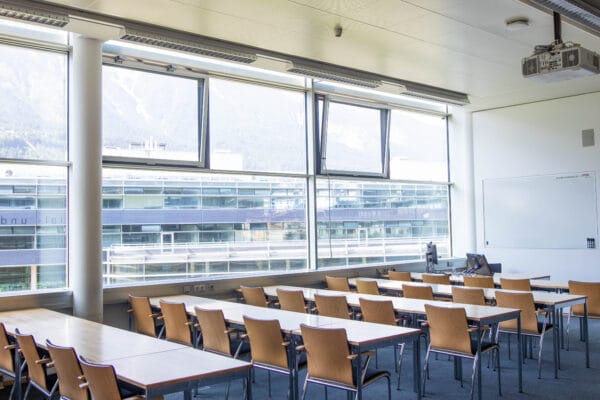
MCI - SR 303
BUILDING:
Management Center Innsbruck
FLOOR:
3
TYPE:
Seminar Room
CAPACITY:
54
ACCESS:
Only Participants
EQUIPMENT:
Beamer, Handicapped Accessible, PC, Sound System, Whiteboard, WLAN (Eduroam), Microphones
The dry Afromontane forests of the northern Ethiopian highlands have long been degraded with remnant patches almost exclusively found around the Ethiopian Orthodox Tewahedo churches. These church forests hold great spiritual value, which has resulted in so-called shadow conservation, i.e., the forests are conserved using a spiritual rather than ecological outlook. This study combined several methodological approaches in order to assess the conservation status of Afromontane forest in the South Gondar Zone and to get an insight into the governance of church forest management and conservation. A remote sensing analysis over the time period from 1984 to 2024 (Landsat, Sentinel-2) confirmed the contribution of church forests to maintaining dry Afromontane forest cover in the South Gondar Zone. Zooming into one of the largest church forests in the region, the Tara Gedam church forest (86ha), we further investigated woody species diversity and aboveground carbon (AGC) based on 30 study plots (r = 15 m). While all of the church forest showed disturbance by human activities and cattle grazing, the forest area near the monastery was best conserved, as indicated by characteristic old-growth species (e.g., Olea europaea subsp. cuspidata) and highest AGC stock (121 ± 48 Mg ha⁻¹). Finally, a total of 24 semi-structured interviews were conducted with local stakeholders such as members of the local Tara Gedam Monastery as well as employees of governmental and non-governmental organizations. The qualitative results underpinned the unbroken spiritual importance of the Tara Gedam church forest. However, considering the livelihood needs of the ca. 200 monastery members as well as the surrounding communities, traditional conservation mechanisms are at their limit. Meanwhile formal protection interventions have not yielded the desired results and are complicated by the overlapping responsibilities of different organizations. Overall, our study showed that the Tara Gedam church forest urgently requires conservation interventions to maintain species diversity and forest functions. Our results provide a basis for stimulating the development of participatory forest management system together with key local stakeholders as well as a baseline for further monitoring.
We and use cookies and other tracking technologies to improve your experience on our website. We may store and/or access information on a device and process personal data, such as your IP address and browsing data, for personalised advertising and content, advertising and content measurement, audience research and services development. Additionally, we may utilize precise geolocation data and identification through device scanning.
Please note that your consent will be valid across all our subdomains. You can change or withdraw your consent at any time by clicking the “Consent Preferences” button at the bottom of your screen. We respect your choices and are committed to providing you with a transparent and secure browsing experience.