

NAME:
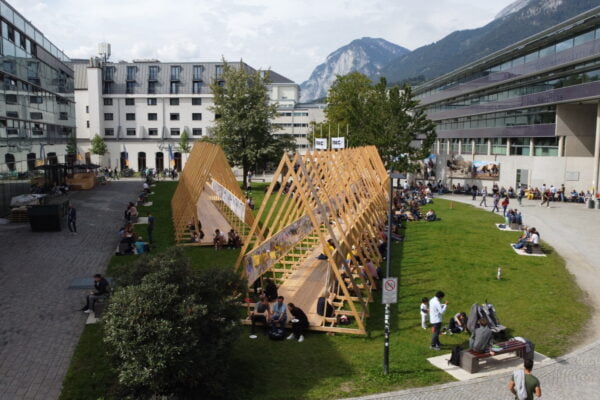
SOWI - Garden
BUILDING:
SOWI
FLOOR:
0
TYPE:
Garden
CAPACITY:
2000
ACCESS:
Public Access
EQUIPMENT:
---
Climate-driven increases in frequencies and intensities of wild fires will affect even relatively humid regions such as the Austrian Central Alps. Higher temperatures in combination with snow-poor winters, lightning activity and more pronounced dry periods favor an increased occurrence of forest fires. During low- to moderate-intensity fires, the resistance of trees is mainly determined by the insulation of their bark, which protects the cambium from lethal temperatures. However, knowledge about fire resistance and bark heat insulation of tree species in Alpine ecosystems is scarce.
We tested the bark insulation of 10 forest tree species in the laboratory by measuring temperature gradients along heat-exposed bark samples. By linking heat transfer parameters, lethal exposure times and bark traits, we were able to demonstrate a strong relationship between bark thickness and cambial temperature responses. Depending on species, also traits like bark density, bark-to-phloem ratio and moisture content considerably contributed to the bark insulation. We further used the obtained dataset to construct cambium mortality models. By integrating species-specific bark traits and allometry data into a semi-infinite solid conduction model, the exposure time necessary for a lethal dose of heat flux to the cambium under different flame temperature scenarios was calculated.
Thick-barked coniferous species like Pinus sylvestris and Larix decidua were found to have the highest capability to prevent critical cambium temperatures from being reached. Mature trees are able to withstand flame temperatures of up to 500 °C for at least 20 minutes. In contrast, it only takes a few minutes of heat exposure until the cambium is killed in thin-barked species such as Picea abies and Fagus sylvatica.
Exact knowledge of the species-specific bark insulation is important to assess the fire resistance of Alpine trees and to enable fire sensitivity assessment in areas of high fire hazards. Implementing cambium mortality models will further help practitioners to better estimate post-fire mortality of injured trees and to improve forest management strategies on fire sites.
We and use cookies and other tracking technologies to improve your experience on our website. We may store and/or access information on a device and process personal data, such as your IP address and browsing data, for personalised advertising and content, advertising and content measurement, audience research and services development. Additionally, we may utilize precise geolocation data and identification through device scanning.
Please note that your consent will be valid across all our subdomains. You can change or withdraw your consent at any time by clicking the “Consent Preferences” button at the bottom of your screen. We respect your choices and are committed to providing you with a transparent and secure browsing experience.