
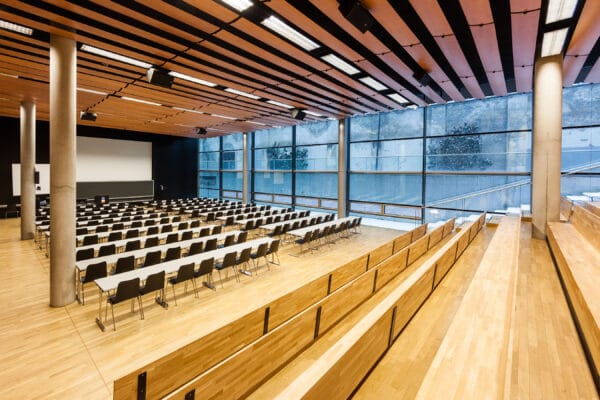
NAME:
SOWI - Aula
BUILDING:
SOWI
FLOOR:
0
TYPE:
Assembly Hall
CAPACITY:
450
ACCESS:
Only Participants
EQUIPMENT:
Beamer, PC, WLAN (Eduroam), Overhead, Flipchart, Blackboard, Sound System, Handicapped Accessible, Microphones, Light Installation
On 28 May 2025, approximately 10 million m3 of rock, sediment, and ice mobilized from the Birch Glacier (Valais, Switzerland), triggering a landslide that destroyed much of the village of Blatten. Numerical simulations using a one-phase MPM model indicated that reproducing the observed runout required a low material friction angle (~13°), suggesting enhanced mobility possibly due to either low ice friction or liquefaction of water-saturated debris. To investigate these mechanisms, we conducted geotechnical field studies of the deposits, most notably near Weissenried (WR), where the landslide ran up nearly 200 m, and in the main deposit area in the Lonza valley (BL), specifically its southwestern and northeastern margins. Investigations targeted the uppermost 1 m of the deposit. Soil samples revealed a fine fraction of ~14% (silt and clay) alongside ~30% coarse gravel and cobbles. Dynamic cone penetration (DPL) tests showed low shear strength in wet sediments, whereas drier sediments exhibited higher resistance. WR deposits appeared drier and boulder-rich, while repeated DPL tests in BL showed temporal variability linked to rainfall and wetting–drying cycles. Field saturated hydraulic conductivity in BL, measured with SATURO tests, averaged 1.5 x 10⁻⁵ m/s, consistent with the relatively fine matrix. The geotechnical data suggest that (i) WR deposits are less saturated than those in BL, and (ii) BL deposits are undergoing compaction and/or moisture cycling. Rainfall infiltration before the event may have wetted the release mass enough for excess pore pressure generation. Hydro-geomechanical conditions indicate basal liquefaction was possible, though ice segregation and associated friction reduction may also have contributed to the large flow mobility. Determining the role of ice melting in generating pore water and weakening the basal layer remains an open and important question.
We and use cookies and other tracking technologies to improve your experience on our website. We may store and/or access information on a device and process personal data, such as your IP address and browsing data, for personalised advertising and content, advertising and content measurement, audience research and services development. Additionally, we may utilize precise geolocation data and identification through device scanning.
Please note that your consent will be valid across all our subdomains. You can change or withdraw your consent at any time by clicking the “Consent Preferences” button at the bottom of your screen. We respect your choices and are committed to providing you with a transparent and secure browsing experience.