
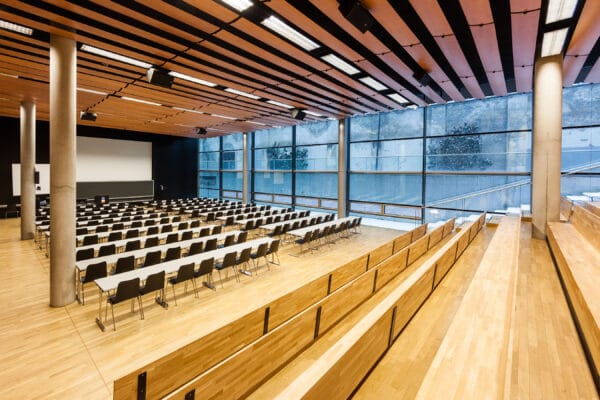
NAME:
SOWI - Aula
BUILDING:
SOWI
FLOOR:
0
TYPE:
Assembly Hall
CAPACITY:
450
ACCESS:
Only Participants
EQUIPMENT:
Beamer, PC, WLAN (Eduroam), Overhead, Flipchart, Blackboard, Sound System, Handicapped Accessible, Microphones, Light Installation
Ongoing atmospheric temperature rise causes deep warming of perennially frozen mountain slopes. The thereby governing process is heat diffusion, in places markedly slowed down by latent heat exchange from local ice melt. This extremely slow combination of processes induces strong, deep and long-lasting delays in thermal disturbance at depth. Such pronounced paleoclimatic effects also affect the mechanical conditions and hydraulic characteristics of rock masses with ice-filled cracks and fissures, the strength, permeability and stability of which are known to be strongly temperature-dependent.
In order to better understand deep, warming-induced effects in the permafrost slope at Kleines Nesthorn, the destabilization of which initiated the catastrophic destruction by a large rock-ice avalanche of the village of Blatten, Valais Alps, Switzerland, a combined thermo-mechanical 2D model calculation is being carried out for the detachment zone before its failure. Present-day near-surface temperatures are first parameterized. A paleo-correction is then applied for an assumed steady-state temperature field at the end of the Little Ice Age around 1850. In a next step, this assumed steady state 2D temperature field is used for a transient calculation of present-day temperature distribution at depth. The resulting changes in the 2D-temperature field at depth are finally interpreted in view of stability changes following laboratory results reported in the literature and geotechnical slope analyses using various shear horizons.
First results indicate a characteristic asymmetric permafrost in a ridge with a warm and a cold side. Depths of permafrost on the cold destabilized slope reached up to more than 100 meters below surface. Since the Little Ice Age, warming and related stability decrease have reached down to roughly 50 – 100 meters below surface, hence affecting large frozen rock masses. At Kleines Nesthorn, permafrost warming and related mechanical weakening at centennial to decadal and annual time scales may most probably have ultimately triggered the failure of a rock mass, which had reached sub-critical topographic and geological stability conditions through much longer time scales. Such a situation and development in time is likely to occur in many places of the Alps and of cold mountains worldwide.